On March 31, 2026, the US Department of the Treasury’s Office of Foreign Assets Control (OFAC) issued a sanctions advisory titled Guidance on Sham Transactions and Sanctions Evasion (Guidance). The Guidance highlights the sanctions risks of what OFAC refers to as “sham transactions” and identifies the characteristics of such transactions. In the Guidance and in its recent enforcement history, OFAC is sending a clear signal that companies should reassess their counterparty diligence policies and procedures to ensure that they do not overly rely on a formal ownership analysis. WilmerHale regularly assists clients in these assessments and has particular experience in connection with the risks identified in the Guidance.
The Guidance
OFAC, more than ever before, has instructed companies to look beyond equity interest for indications that a sanctioned person has a property interest in a legal entity.
US sanctions prohibit US persons—US citizens, permanent residents, corporations and foreign branches, and persons within the United States—from dealing with sanctioned persons or their property and property interests unless authorized by OFAC. Pursuant to the 50 Percent Rule, OFAC considers an entity to be blocked if it is owned 50 percent or more, directly or indirectly, individually or in the aggregate, by one or more sanctioned person. In longstanding guidance, OFAC explained that the “50 Percent Rule speaks only to ownership and not to control.” In 2014, OFAC stated that “US persons are advised to act with caution when considering a transaction with a non-blocked entity in which one or more blocked persons has a significant ownership interest that is less than 50 percent or which one or more blocked persons may control by means other than a majority ownership interest,” because such entities “may be the subject of future designation or enforcement action by OFAC.” (emphasis added). Such guidance has consistently reinforced the importance of ownership with respect to the blocked status of an entity.
However, in the Guidance, OFAC places the compliance emphasis on what it describes as “numerous instances where sanctioned persons have employed opaque legal structures … to conceal their continuing interest in a variety of types of property.” Such “sham transactions” are “transfers” or “arrangements” that “conceal—rather than genuinely extinguish—a continuing property interest.” In other words, OFAC alleges that sanctioned persons increasingly are hiding that they de facto continue to have a property interest. As OFAC notes, “sham transactions do not terminate a blocked interest in property,” and OFAC will apply “functional definitions” of “interest” and “property interest” “that look beyond legal formalities to underlying practical and economic realities.”
OFAC highlights a non-exhaustive list of “red flags” companies must consider in this regard when reviewing a transaction for compliance with US sanctions:
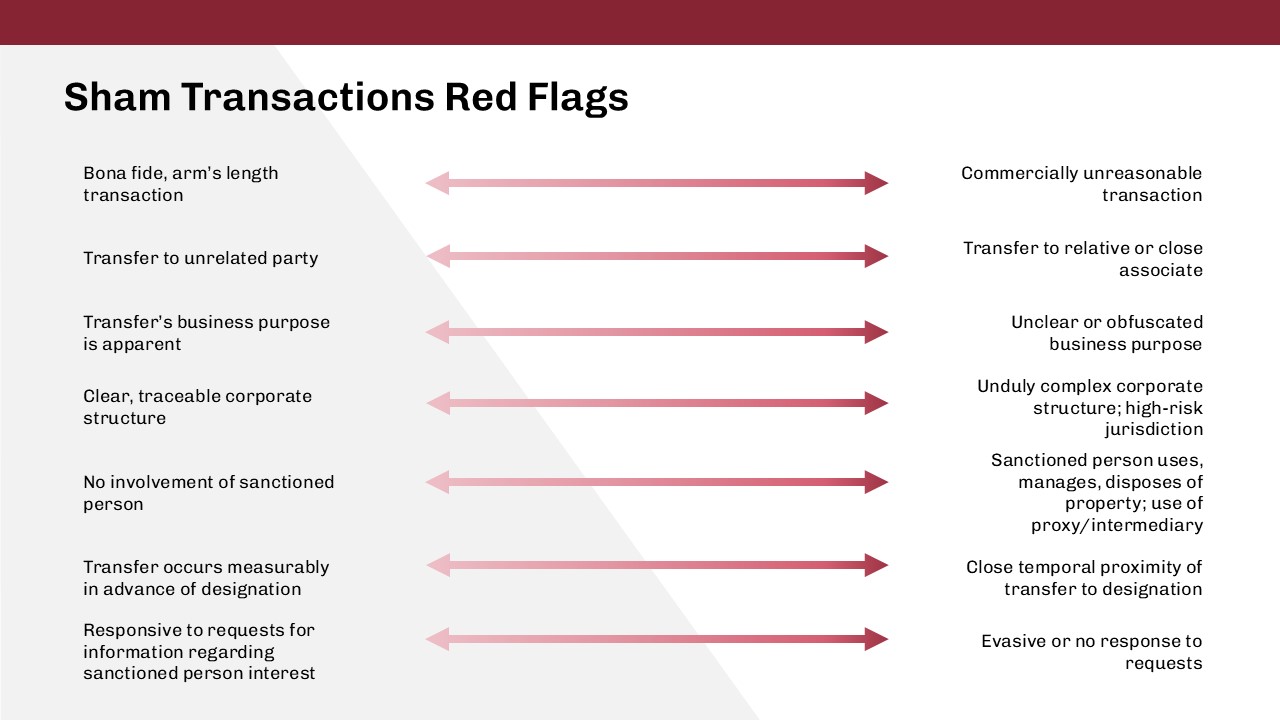
Sham Transactions Red Flags: The Guidance notes that “no factor—alone or in combination with others—is determinative.” This visualization is for illustrative purposes only; it does not constitute legal advice.
Enforcement Impact
This new Guidance demands a reconciliation with OFAC’s longstanding 50 Percent Rule. A benefit of the 50 Percent Rule has been that it effectively serves as a bright line. When a blocked person has maintained a non-majority interest in a legal entity, that legal entity is not blocked, and the risks associated with the blocked person could often be managed through the design and implementation of thoughtful, diligent safeguards. In the Guidance, OFAC is not necessarily abandoning the 50 Percent Rule. Indeed, it stated in a recent enforcement case that while the 50 Percent Rule analysis “may be sufficient to address OFAC sanctions risk,” certain cases, such as those “involving opaque legal structures or the use of proxies that may obscure a party’s interest” may demand “a more exhaustive analysis.” OFAC has previously emphasized the breadth of the definition of “property interest.” So OFAC could seek to reconcile the Guidance with the 50 Percent Rule by asserting that a blocked person’s “property interest” may manifest outside an equity ownership. The Guidance serves as a marker, which may assist OFAC in satisfying its obligation to give fair notice in future enforcement actions involving relevant fact patterns.
OFAC applied this broader definition of property interest last year in four actions against so-called “gatekeepers”—professional service providers, such as investment advisers, accountants, attorneys, and trust and corporate fiduciaries—for their roles in managing assets related to a blocked person. Notably, in the Penalty Notice issued to GVA Capital Ltd., OFAC expressed skepticism of gatekeepers’ reliance on “formalistic ownership arrangements that obscure the true parties in interest behind an entity or investment.” In the IPI Partners LLC settlement, as noted above, OFAC made clear that it expects gatekeepers to scrutinize whether blocked parties retain influence or decision-making authority, including through proxies or other arrangements. Finally, in a December 9, 2025, settlement with an Individual, OFAC stated that gatekeepers are sophisticated parties and are “often better positioned than others to monitor for and identify ways” in which a sanctioned person retains a property interest. The Guidance, read together with this recent enforcement history, demonstrates that OFAC’s enforcement division—more than ever before—will expect companies to leverage their “better positioned” perspective when diligencing the role any blocked person might play vis-à-vis their counterparties.
These developments are part of a trend of relatively more aggressive OFAC enforcement. In 2025, the share of enforcement actions in which OFAC determined the conduct to be “egregious” was significantly higher than in prior years—nearly 65 percent of actions compared to 42 percent in 2024, and between 0 and 35 percent since 2020. OFAC also issued a record number of Penalty Notices in 2025—three penalty notices, as compared to only one Penalty Notice in the entire period from 2020 to 2024. While such trends could reflect the agency’s resourcing constraints and prioritization, they also demonstrate a shift in the breadth of OFAC’s view of what constitutes knowledge and/or willful behavior—factors contributing to a finding of egregiousness. Further, the increase in Penalty Notices may also reflect OFAC’s reduced patience in settlement negotiations in at least certain types of enforcement cases.
Broader Regulatory and Enforcement Implications
The Guidance should also be read in conjunction with developments in other national security related areas, such as export controls. As detailed in our prior client alert, in September 2025, the Department of Commerce’s Bureau of Industry and Security (BIS) issued an interim final rule, known as the Affiliates Rule, that imposes restrictions, under the rule of most restrictiveness, on entities with 50 percent or greater ownership by one or more parties on the BIS Entity List, the MEU List, or, in some cases, OFAC’s List of Specially Designated Nationals and Blocked Persons (SDN List). Although implementation of the Affiliates Rule is paused until November 10, 2026, companies should be prepared to comply once the rule goes into effect. In contrast to the Guidance, the Affiliates Rule still relies on formalistic legal structures and ownership; however, both the rule and the Guidance impose significant diligence burdens, requiring companies to identify all of a counterparty’s ownership to ensure compliance with applicable requirements, while also peeling back layers to understand control and other “practical” and “economic” realities.
How Can Companies Prepare?
With these changes, OFAC and BIS are demanding more and more of companies transacting globally. Companies will need to reconsider their existing compliance infrastructure to ensure it accommodates OFAC’s evolving interpretations of “interest” and “property interest,” as well as satisfies BIS’s requirement to identify all of an entity’s ownership or else seek a license. Because sanctions and export controls enforcement are unlikely to decrease under the Trump Administration, companies should expect to see increased risks in this space throughout 2026 and the coming years. WilmerHale’s experienced team is well positioned to advise clients throughout the compliance and enforcement cycle.
Associate Kyrylo Korol provided invaluable assistance to this alert.